
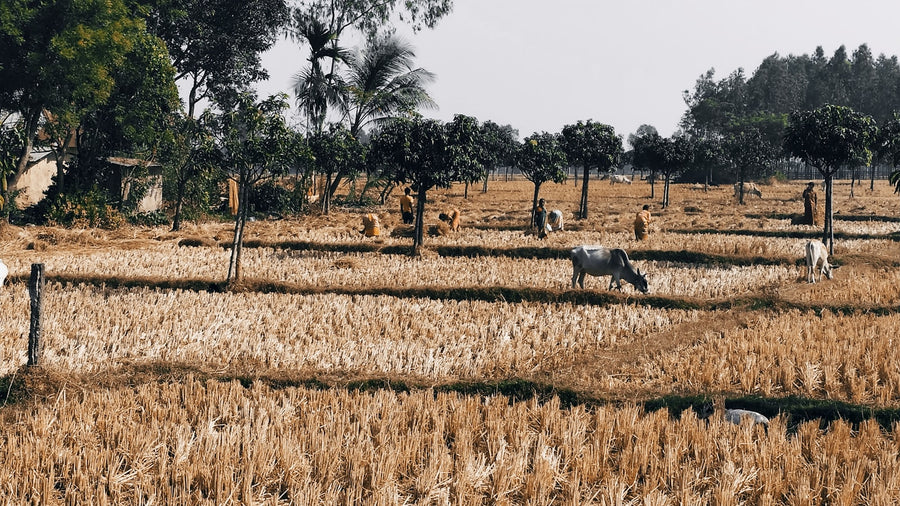
Cattle grazing on dry farmland among trees
Uttarakhand The herd walks to forage. Nobody drives them.

Where it comes from

One valley, one herd, one method

Himdhara buys milk from smallholder families in the upper Uttarakhand valleys, where Badri cows — a small, hardy indigenous breed — walk the slopes and eat what grows there. No compound feed, no confinement, no hormones.

The milk never leaves the hills. It is set into curd overnight with a native starter, churned on a wooden bilona before dawn, and clarified over a wood fire the same morning. Nothing is transported, pooled, standardised or bleached.

We pay above the local cooperative rate, because a method this slow only survives if the people doing it can afford to keep doing it.

8,200 ft
Grazing altitude
30 L
Milk per litre of ghee
14
Partner families

What we will and will not do

The rules we set ourselves

These are not marketing positions. They are the constraints that decide what we can sell and how much of it, and they are the reason the catalogue is short.

We will not standardise the product

Colour, aroma and grain change with the season and with what the herd ate. We could correct for that. We do not, because correcting it means adding something.

We will not sell a batch that has not been tested

A sample from every churn goes to an accredited laboratory before any jar ships. If a batch fails, it does not get sold — it does not get discounted or blended into the next one.

We will not grow faster than the herd

Yield is limited by how many cows graze those slopes and how much milk they give in a given season. When a batch sells out, the honest answer is to wait, not to buy milk from elsewhere.

We will not launch a product we cannot trace

Shilajit Gold Resin is on sale now, with its batch certificate on the lab reports page. Honey and the rest of the pantry follow, each only once it has the same batch-level testing behind it.

From the people cooking with it

What buyers say

  • It smells like my grandmother's kitchen, which I did not expect from something bought online. The grain is real — you can see it set unevenly in the jar.
    Shreya D. Verified buyer · Pune
  • I checked the batch code before I opened it, mostly to see whether the report would actually be there. It was, and it matched the jar. That is the reason I reordered.
    Ankit B. Verified buyer · Bengaluru
  • Half a spoon in dal is enough, which is not true of the ghee I was buying before. It works out closer in cost than the price suggests.
    Varun N. Verified buyer · Delhi